
Building on our strengths: renewal of the MD Research Project
Building on our strengths: renewal of the MD Research Project
| UNIVERSITY OF SYDNEY |
| Team Members Dr Joanne Hart (Academic Lead, MD Research) Prof Richmond Jeremy (Clinical Lead) Dr Rajneesh Kaur (Senior Lecturer) Ms Sally Middleton, (Education Support) All members of MD Projects, Sydney Medical Program |
What was the main aim of this project?
The overall aim of the Sydney Medical Program’s MD Project is to teach students the basic tenets of medical research through a hands-on research project experience. During the project, students develop key research and generic skills, including self-motivation, time management, organisation problem-solving, and building relationships in clinical or research laboratory environments.
The University of Sydney introduced a new postgraduate Doctor of Medicine (MD) Program in 2020, including a new format for the compulsory, individual student research project now run in a dedicated block in Year 3. With the renewal of the MD curriculum, we had the opportunity to revise our MD Project and address a key concern previously raised by both students and supervisors: the lack of a dedicated time for the MD Project. [1, 2].
The pre-2020 MD Project was very successful, but the students were required to complete their projects in their own time on top of the rest of the curriculum. Competing learning priorities meant project milestone assessment tasks acted as extrinsic motivators and barriers to overcome, instead of activities that meaningfully contributed to student learning [2]. Thus, with the introduction of the new MD curriculum, a 14-week block in Year 3 was quarantined for completing the MD Project.
Learning theory underpinning the project
The pedagogical framework for the MD Project employs active, experiential, project-based learning in a research context, with individual projects being supervised by academic or clinical staff mentors or mentoring teams. Throughout the MD Project block an additional series of workshops on various research methods, literature search strategies, statistical analysis, scientific presentations and scientific writing is provided to support the student projects.
The MD Project is scaffolded with milestone tasks that guide the students through the research process, from project planning to the submission of a scientific report.
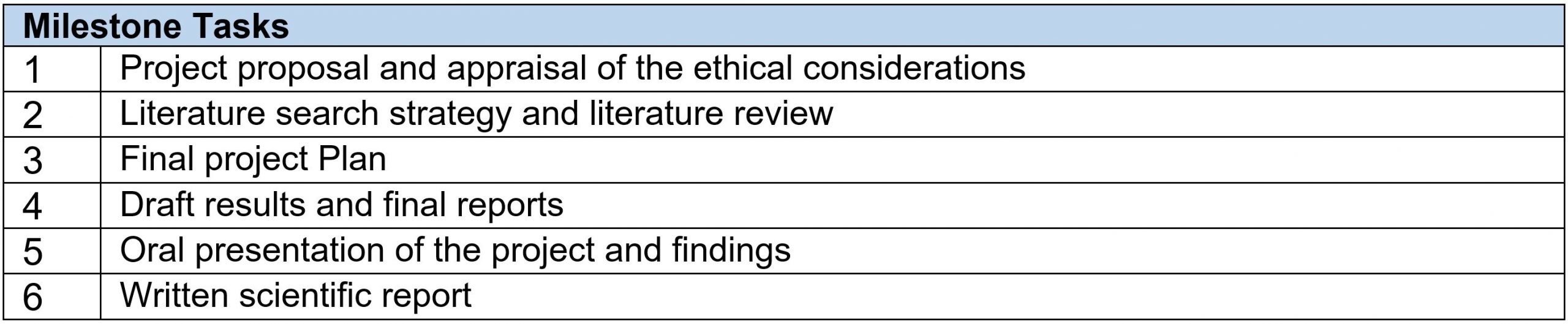
Integration with other components of the MD curriculum
The MD Project is a key component of the vertical curriculum theme of Research, Evidence and Informatics, which runs throughout the four-year MD Program. Research methods and research ethics are taught in Year 2, along with evidence-based medicine, where students are taught to be effective users of medical research knowledge. The MD Project then requires the students to do the research and puts them on the pathway to future development of independent research capabilities.
Learning outcomes
The learning objectives of the MD Project are listed below:

How was the MD Project implemented?
The University of Sydney MD Program has about 300 students per year. In Year 3, students undertake an individual research project on any topic related to health or medicine. Project data may be quantitative, qualitative or mixed methods, and a wide scope of project types are accepted, including:
- narrative, scoping or systematic literature review
- study from inception to completion, in laboratory, clinical, public health or other fields
- project centred on development of a product (e.g. an educational video)
- project using publicly available health-related data
- developing a study protocol and ethics application.
The MD Project team is comprised of several academics and education support staff. Projects are delivered at nine locations across NSW, including urban and rural clinical schools and affiliated research institutes. This involves recruitment of 150+ research supervisors, ~10 research co-ordinators and a further ~10 education support staff. The MD Project team oversees the recruitment for all projects and the allocation of students to their projects.
General information about the MD Project Program is available to students from commencement of the MD Program. Students in Year 2 are then introduced to the MD Project by the MD Project team staff via information sessions and online Q&A sessions. Project topics are posted for students to select from, with projects allocated according to student preference. All information about the MD Project is presented on a dedicated Canvas website that students and supervisors can access.
Many of the projects require human or animal ethics approvals. All ethics approvals are the responsibility of the research supervisor, however the MD Project team ensures that these are in place before the MD Project block. The MD Project team can also advise research supervisors on the basics of ethics applications, study design and statistical analysis.
Assessment of learning objectives
The MD Program has programmatic assessment, thus the milestone tasks, the final scientific report, and professionalism and engagement with the project are all included as data for the programmatic assessment process. Submitted tasks graded borderline or not meeting standards require revision and resubmission.
Detailed rubrics are available for all the assessed tasks and they are all mapped back to the stated learning objectives. The final assessment task is a 3000-word written report in the form of a scientific paper. These reports are assessed by academic staff with no conflicts of interest using a standard rubric, and students receive feedback on their reports from a minimum of two assessors. The final report marking is a large undertaking involving co-ordination of around 200 academic assessors.
How has the impact of this project been evaluated?
We ran the first 14-week MD Project in Jan-Apr 2022. Research skills attained by students were assessed by survey at the beginning and then again at the end of the block, using the Research Spider [3]. The data show the students perceive a significant improvement in their research skills across all domains, except applying for research funding, which is outside the scope of the MD Project (Figure 1).
 Figure 1. Students’ self-reported research skills in ten research skill areas pre and post the MD Project. Likert Scale of 0 (no experience) to 5 (highly experienced), n=182, P<0.0001, paired t-test.
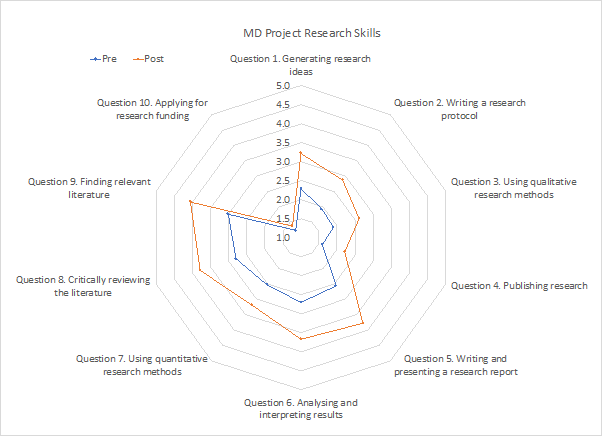 Figure 1. Students’ self-reported research skills in ten research skill areas pre and post the MD Project. Likert Scale of 0 (no experience) to 5 (highly experienced), n=182, P<0.0001, paired t-test.
Student reflections
There were about 30 different research and generic project-related skills cited by students as important skills they learnt by completing the MD Project. Students report that the top three skills they learnt during the MD Project were searching and reviewing the literature (15%), time management skills (9%) and scientific writing skills (8%). They report having a better understanding of the overall research process, statistical and other data analyses, and are upskilled in the use of software that supports research.
A selection of quotes on the best things learnt during the MD Project:
- “Developing familiarity with many aspects of the research process as a whole”
- “The opportunity to do a project that involved so much hands-on experience”
- “The importance of effective time-management and planning when conducting a research project”
- “The importance of effective communication and collaboration with other members of a research team to ensure that goals are met”.
Staff reflection
The supervisor reports on their students at the conclusion of the 14-week project block were resoundingly positive, many reporting their students were outstanding, highly engaged, dedicated to the project and progressed well with the project and learning research skills. When asked to give general feedback on their student’s overall performance in the MD Project, Supervisors reported:
- “My student was engaged with the research project and showed an eagerness to learn and develop their research skills.”
- “My student posed thoughtful research questions and listened carefully to advice provided by myself and others. It has been a pleasure working with them on this project.”
- “My student has shown outstanding levels of commitment, professionalism and tenacity during this project. They clearly became invested in the relevance and importance of the work.”
Project outputs
A number of students have published or intend to submit their project findings for peer-reviewed publication, or present their results at national or international conferences. These are very desirable outcomes but are not required for the MD Project.
Conclusion
Overall, the compressed timeline of the new MD Project was beneficial, as we retained the learning gains and avoided the stop-start progress of the previous MD Project Program. Both students and project supervisors reported a positive experience and that students attained both research and project management skills.
References
[1] Kaur, R. et al., Perceived research skills development and student satisfaction with a mandatory research project: A survey of five cohorts from 2017-2020, presented at ANZAHPE, online conference 2022.
[2] Hart, J. et al., Research supervisors’ views of barriers and enablers for research projects undertaken by medical students; a mixed methods evaluation of a post-graduate medical degree research project program. BMC Medical Education, 2022. 22(1): p. 370-370.
[3] Smith, H. et al., The ‘Research Spider’: a simple method of assessing research experience. Primary Health Care Research & Development, 2002. 3(3): p. 139-140.